
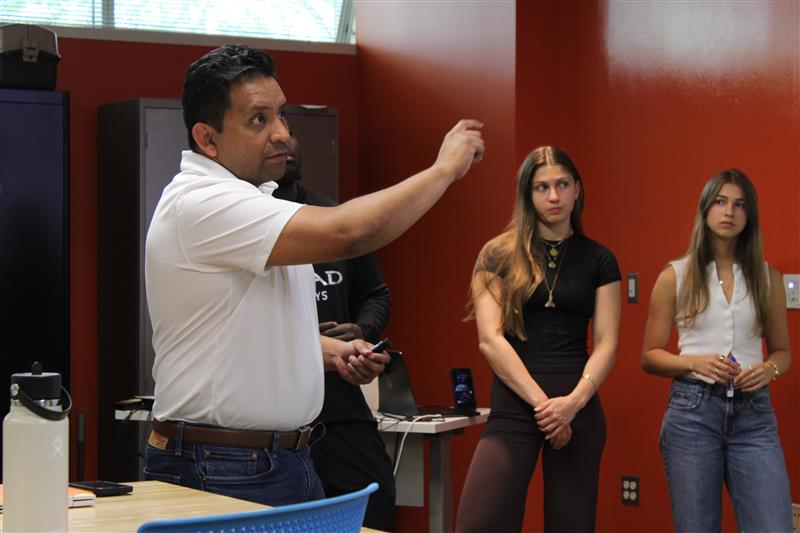
Omar Garcia, associate director of CREATE-X Learn, teaches Startup Lab.
CREATE‑X Startup Lab serves as the foundation of Georgia Tech’s entrepreneurial pathway, giving students a structured but low‑pressure environment to explore the unknown and develop entrepreneurial thinking. Recently updated curriculum provides clearer structure, shared language, and hands‑on tools that emphasize real‑world discovery, iteration, and reflection over polished pitches. Students learn by engaging directly with people, testing assumptions through minimum viable experiments, and documenting evidence‑based decisions they can carry into future courses or careers. By welcoming students from all disciplines, experience levels, and personality types, Startup Lab equips learners with confidence and transferable skills that extend far beyond entrepreneurship.
You don’t need an idea to begin. You don’t need a co‑founder, a pitch deck, or a perfect plan. What you need is curiosity, a willingness to talk to real people, and a place where it’s safe to learn by doing. That’s exactly what CREATE‑X Startup Lab delivers.
Omar Garcia Urdiales, CREATE‑X’s associate director of Learn, brings a global entrepreneurial experience to Georgia Tech: founder and CEO of a startup operating in the AWS Accelerator Loft, longtime startup coach in Europe’s major innovation hubs, lecturer across multiple universities, and an external doctoral researcher in entrepreneurship and digitalization. He brings this background to his teaching of Startup Lab’s latest iteration – a significant redesign developed by VentureLab’s Director Keith McGreggor. McGreggor created the course and has evolved it over many years, building on its initial success.
“This new iteration of Startup Lab allows us to meet students exactly where they are,” said McGreggor. “By doing this, we give them the strongest foundation possible, providing them with the tools to grapple with uncertainty and build their confidence.”
Startup Lab has long anchored the Institute’s entrepreneurial pathway with clearer structure, a unified language, and a deeper focus on reflective growth, so more Georgia Tech students can discover (and trust) their own entrepreneurial judgment.
Startup Lab is expanding responsibly, with six sections in Atlanta and additional global sections in France and Asia-Pacific taught by faculty trained in the curriculum. Students here benefit from a program that’s learning across borders and bringing that learning back to campus.
“Startup Lab is not about becoming an entrepreneur, but about engaging in the unknown and adopting entrepreneurial behavior, which can be applied to all career paths,” Urdiales said. “Students become better equipped to identify problem spaces and solve them through evidence-based building.”
Start Where You Are
Urdiales emphasized that Startup Lab is built for students who are still exploring, uncertain, or are simply curious.
“Many students tell us they’re curious about entrepreneurship but feel not ready,” he said. “They worry they’re too introverted for customer interviews or assume Startup Lab is only for people with fully formed ideas. In fact, those are the most common misconceptions.”
The course’s first few weeks focus on training students to see struggles and patterns in the world. Then, they apply those skills on a team, exploring, designing, and testing a concept with real people. The nonnegotiable outcome isn’t the best idea; it’s a more confident, evidence-driven version of you.
“Startup Lab is strengthening that self-awareness. All of us who are entrepreneurs, we don’t grow linearly. We have various iterations of how we see things,” Urdiales said. “This ability to see patterns or to see problems with customer discovery, it’s a learning process and a growth process.”
Building Muscle Memory
Urdiales said that students won’t have a passive experience in the lab.
“To become an entrepreneur, you need to do it. You need to engage with customers. You need to get out of the building,” he said. “It gives you the ability to incorporate theoretical frameworks into practical solutions and then understand these more practical outcomes.”
Aligning with CREATE-X’s culture of continuous iteration, Startup Lab is tightening the hands-on core of the course around four simple, repeatable tools so that entrepreneurial thinking becomes muscle memory, not a one-off assignment. The new iteration of the curriculum, developed by McGreggor, helps students learn to:
- Elicit grounded problem stories from real people (and separate observations from interpretations).
- Make explicit strategic decisions — who you serve, what you offer, how you deliver, how you get paid — and back them with discovery evidence.
- Externalize your logic with clear Business Model Canvas snapshots (hypotheses ≠ decisions ≠ open questions).
- Design minimum viable experiments (MVEs) that can falsify assumptions, not just confirm them.
“What we have is a frontier model in entrepreneurial education,” said McGreggor. “The result is a course that teaches sound decision making and builds entrepreneurial confidence that rewards authentic discovery and iteration over performative polish. It creates a more solid foundation for entrepreneurial thinking and sets students up to engage more deeply with everything that follows in their CREATE-X pathway.”
Reflection as a Feature
As a part of Startup Lab, instructors integrate reflection throughout the semester, which helps students notice patterns of work, make small experiments, and adjust based on what’s learned. Students often worry they’re not the founder type or that their introversion will hold them back; Startup Lab reframes those worries as raw material for growth, including communication skill building and one-on-one interactions you won’t always get in higher-level courses.
Startup Lab integrates HaradaLite — McGreggor's adaptation of the Japanese Harada Method — as a weekly reflection practice in which students keep a reflection log, helping them notice patterns of work, run small experiments, and adjust based on what's learned. With this approach, educators are able to measure the growth of entrepreneurial confidence by self-report, leading to a more quantitative approach to teaching.
A Common Language Across CREATE‑X
There’s no mandated order for CREATE-X courses. Startup Lab simply makes the next steps clearer by providing a shared language and milestone structure across sections and instructors, so whatever comes next (I2P, Capstone, Launch, or an internship), you can carry forward a coherent, evidence- aware story of your work.
“All CREATE‑X Learn sections will work with the same milestone objectives,” Urdiales said. “Students trained in Startup Lab are already trained in the muscles of entrepreneurship. They’re more equipped to go into Make and Launch or be a leader within their industry.”
Built To Be Inclusive Across Disciplines and Needs
Startup Lab is about becoming the kind of person who can see opportunities, reason from evidence, and make better decisions when the path isn’t obvious.
- You do not need an idea or a pre‑built team — curiosity is enough.
- You do not need special permits to enroll. Startup Lab is open to anyone ready to explore.
- You can benefit from the course before or after I2P or Capstone, since there’s no fixed order to the CREATE‑X pathway.
- Introverts are welcome. The course intentionally builds communication skills through structured, low-pressure interviews and guided interaction.
“Startup Lab helps students see the world’s problems and fill the gaps with fresh ideas, teaching them to see and understand the important difference between evidence and inference,” said McGreggor. “This lays the foundation that leads to good founders, and builds the entrepreneurial confidence needed to succeed.”
What You’ll Actually Do
Students in Startup Lab can expect a workshop-heavy, conversation-rich semester with weekly artifacts, scenario-based decision prompts, startup reports, and quizzes that keep you honest about what you’re learning. You’ll assemble a Continuity Pack near the end: a compact bundle of your best discovery evidence, decisions, MVEs, economics, and final story slides so your future self (or your I2P/Launch application) can pick up right where you left off.
The course also sets norms for modern tool use. AI is welcomed as a coach and organizer, after your own baseline thinking and research, and as an enhancement of the real conversations you have. That matters because Startup Lab’s promise is that you build solid judgment under the test of uncertainty, critical to the world of today and the future that is being built.
Jump Into Startup Lab
You don’t have to have it all figured out. If you’re a first-year student still exploring, a junior craving real-world projects, or a senior looking to stand out in interviews, Startup Lab is for you.
Seats fill quickly across all sections — and for good reason.
This course gives you the clearest, most supportive on‑ramp into CREATE‑X, with a global methodology, a unified curriculum, and instructors who believe deeply in your potential to grow. Learn how to think entrepreneurially. See the world differently. Build the confidence that will follow you long after the semester ends.