
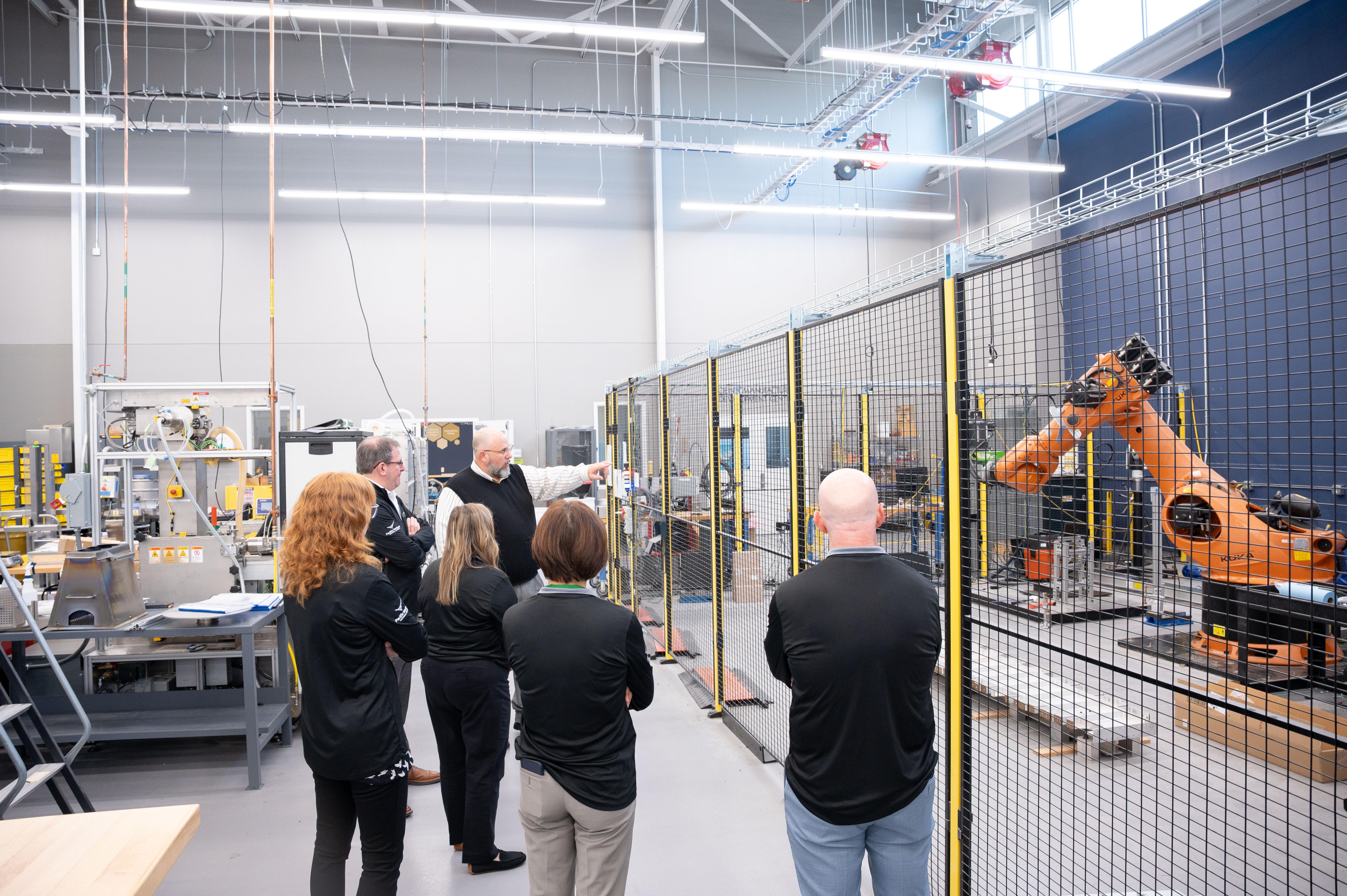
Georgia Tech is partnering with Siemens and Stanford University to host the inaugural Foundry School lecture on Nov. 12, launching a national initiative to strengthen America’s advanced manufacturing workforce. Hosted at Georgia Tech’s Advanced Manufacturing Pilot Facility, the event will showcase how artificial intelligence, robotics, automation, and digital technologies are transforming modern factories while highlighting the skills needed to prepare American workers for the future of manufacturing.
As U.S. manufacturers face growing demand for skilled workers, Georgia Tech is partnering with Siemens and Stanford University to help prepare the American workforce for the next generation of factories.
On Nov. 12, Georgia Tech will host the first Foundry School lecture, a Stanford University-led initiative designed in collaboration with the U.S. Department of State. The lecture launches a national initiative that brings together universities, industry leaders, and workers to advance manufacturing education and strengthen U.S. competitiveness.
Foundry School: Digital Factory — The Future for the American Worker and U.S. Manufacturing will take place from 1:30 to 5 p.m. at Georgia Tech’s Advanced Manufacturing Pilot Facility (AMPF) in Atlanta. The event will explore how digital technologies are reshaping factories and the skills needed to operate them.
“Foundry School is a transformational effort to galvanize workforce development in the advanced manufacturing sector across Pax Silica partner countries and economies. Participants share the common objective of advancing U.S. technology leadership by teaching advanced manufacturing, sharing the tools and technology that make it work, and helping partner countries build their own skills. The curriculum, toolkit, and training program Foundry School produces will equip American students and emerging leaders in partner countries with the knowledge, skills, and tools in advanced manufacturing and enabling technologies, and will promote American-aligned technology governance through rigorous technical content, policy frameworks, and hands-on engagement with American technology leaders,” said Under Secretary of State for Economic Affairs Jacob Helberg.
Inside the Digital Factory
The inaugural event will offer a firsthand look at technologies transforming modern manufacturing.
“America’s global competitiveness will be defined by our ability to translate our research and discoveries into viable solutions and products made here by American workers,” said Tim Lieuwen, interim president of Georgia Tech. “At Georgia Tech’s Advanced Manufacturing Pilot Facility, our researchers are integrating artificial intelligence, automation, robotics, and digital manufacturing to revolutionize how factories operate and reimagine our nation’s manufacturing scale and capacity. The Foundry School will help ensure America’s workforce is ready to lead that transformation, and we’re honored to be a part of this critical national initiative.”
Attendees will tour Georgia Tech’s AMPF, where live demonstrations will showcase digital twins, industrial artificial intelligence, robotics, connected equipment, and other technologies changing how products are designed and produced.
A panel discussion will explore how technology and talent can work together to strengthen U.S. manufacturing. The event will feature leaders from government, industry, academia, and workforce development, including:
- Rep. Rich McCormick, U.S. Representative for Georgia's 7th Congressional District
- Tim Lieuwen, Interim President, Georgia Tech
- Del Costy, Managing Director, Americas, Siemens Digital Industries Software
- Jim Kelleher, President and CEO, Georgia Association of Manufacturers
- Praveen Rao, Global Head of Manufacturing, Google
- Greg Dozier, Commissioner, Technical College System of Georgia
- Lisa Winton, CEO, Winton Machine
- Aaron Stebner, Associate Director of the Georgia Tech Manufacturing Institute
“The opportunities that come from bringing the physical and digital worlds of advanced manufacturing together will depend on the skills of the workforce. Helping America’s manufacturers to train their workers on the emerging technologies that will enable the next generation of factories is critical. We’re honored to be a part of the Foundry School initiative from its inception, where Siemens brings more than a century of industrial expertise and digital transformation capabilities to the nation’s reindustrialization movement,” said Del Costy, managing director, Americas, Siemens Digital Industries Software.
Building America's Manufacturing Workforce
Launched in partnership with Stanford University in September 2026, Foundry School aims to strengthen the advanced manufacturing workforce as U.S. manufacturers face a projected need to fill 3.8 million jobs by 2033.
The initiative features a Stanford-led curriculum delivered in collaboration with seven partner universities, including Georgia Tech. The program will offer 17 sessions across eight university campuses, combining regional lectures and Stanford-based coursework with insights from founders, CEOs, and industry leaders.
Joseph M. DeSimone, a chemical engineering professor at Stanford and the faculty lead for the project, said, “Georgia Tech exemplifies the extraordinary role a university can play as an anchor for economic development — nurturing talent, turning discoveries into industries, and creating opportunity across the Southeast. It is fitting that Foundry School’s inaugural lecture takes place here, bringing together Siemens, Google, and the Georgia Association of Manufacturers to help shape the next chapter of American manufacturing. Foundry School builds on that spirit of partnership, connecting universities and industry to prepare people to lead, accelerate innovation, and strengthen the communities where manufacturing grows. We are delighted to launch this national effort at an institution that so powerfully demonstrates what is possible.”
The lecture can be livestreamed here.
Learn more about Foundry School at foundryschool.stanford.edu.