
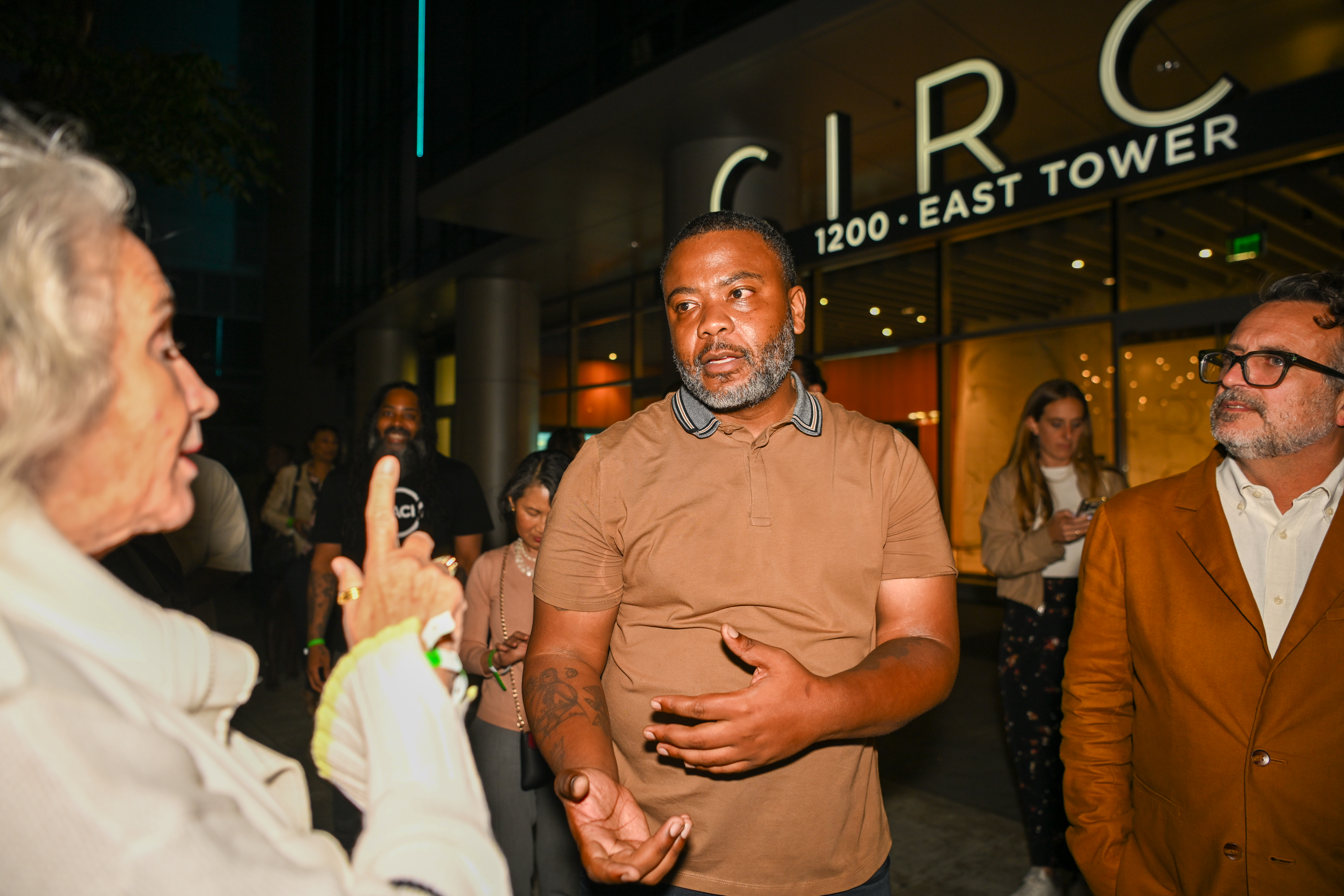
ATDC portfolio company Gaia Agricultural Technology is bringing its patented Gaia Box technology to Downtown Los Angeles through a pilot with the Los Angeles South Park Business Improvement District. Designed to generate and store energy while supporting plant growth, Gaia Box is currently powering decorative lighting near Pico Station and Crypto.com Arena. With support from ATDC coaching and mentorship, Gaia has continued refining its technology, story, and path toward commercialization while exploring opportunities in Georgia, Maryland, and other markets.
In Downtown Los Angeles, damaged lighting infrastructure, unlit pedestrian corridors, and temporary
battery trailers have created challenges for businesses, residents, and visitors. As the city prepares for
major global events in the coming years, the need for reliable energy infrastructure that complements the
surrounding environment has become increasingly important.
Clean technology company Gaia Agricultural Technology is working to help Los Angeles address some
of those challenges through Gaia Box, its patented infrastructure system designed to generate and store
energy while supporting plant growth.
Using a closed-loop water system, Gaia Box integrates energy infrastructure with plant-growing space. It
can work alongside solar, utility power, or battery storage, addressing multiple energy needs while
contributing to a more attractive streetscape.
Gaia's first public Gaia Box installation is operating near the Los Angeles Department of Transportation's
Pico Station, close to Crypto.com Arena. Through a pilot partnership with the Los Angeles South Park
Business Improvement District, the system is supporting decorative lighting along Flower Street while
being tested in a high-traffic urban environment. The year-long pilot could include up to 10 Gaia Box
units.
Solving Problems With Clean Technology
For founder and CEO James Highsmith, Gaia Box was never intended to solve an infrastructure problem
alone.
"We come from the community," Highsmith said. "We weren't trying to build a product just to sell. We
were trying to solve problems that we were experiencing ourselves."
The idea grew from a challenge Highsmith and co-founder and inventor DeMarco Millard encountered
firsthand. When colder temperatures required crops they were growing outdoors to be moved indoors,
the resulting increase in energy costs raised a larger question: Could they create one solution that
addressed both energy use and food production?
Building it came with challenges. As a hardware startup operating across agriculture, clean energy, and
infrastructure, Gaia did not fit neatly into an established category. Highsmith recalls years of skepticism
from people who struggled to understand the concept.
"We went through years of being told we didn't know what we were doing," Highsmith said.
Those experiences forced Gaia to refine both its approach and how it communicated its value. That
evolution became an important part of the company's work with the Advanced Technology Development Center (ATDC) at Georgia Tech.
With coaching from ATDC Sustainability Catalyst Jennifer Singh, Highsmith said Gaia learned to explain
the company from a systems perspective, connecting energy, agriculture, infrastructure, and community
needs, while also communicating its impact on a human level.
"ATDC taught us the importance of communicating with story and not losing the plot," Highsmith said.
Through ATDC's coaching, Feedback Friday, Entrepreneurs Night, mentorship, and strategic guidance,
Gaia also gained relationships and feedback that helped prepare the company for conversations with
customers and partners. Highsmith credits Singh, Lisa Bailey, and other advisors with contributing to the
company's growth.
Partners in Sustainability
In Los Angeles, Nolan Marshall III, CEO of the Los Angeles South Park Business Improvement District,
became a key pilot partner, allowing Gaia to demonstrate Gaia Box against real infrastructure needs
Another step toward commercialization came through Gaia's partnership with the Alabama Mobility and
Power Center (AMP) at The University of Alabama. Working with AMP Research Director Mike Malley
and his team, Gaia gained support related to battery-backed infrastructure, customer energy
requirements, battery sizing, safety considerations, installation, and maintenance. AMP also provides
engineering expertise that strengthens Gaia's ability to prepare for larger projects.
The company's vision extends beyond the technology. Gaia plans to incorporate workforce development
into future rollouts, creating opportunities for people to gain experience and certifications in plumbing,
electrical work, and construction — trades directly connected to building and maintaining Gaia Box units.
"These systems should create value for the people who live around them, not just the people who
purchase them," Highsmith said.
With its first Los Angeles Gaia Box operating and additional configurations planned, Gaia is exploring
opportunities in Georgia, Maryland, and other markets as it moves toward broader commercialization.
For a company that spent years being told its idea did not make sense, the Los Angeles rollout is an
opportunity to test how resilient infrastructure can address multiple challenges while creating value for the
communities it serves.